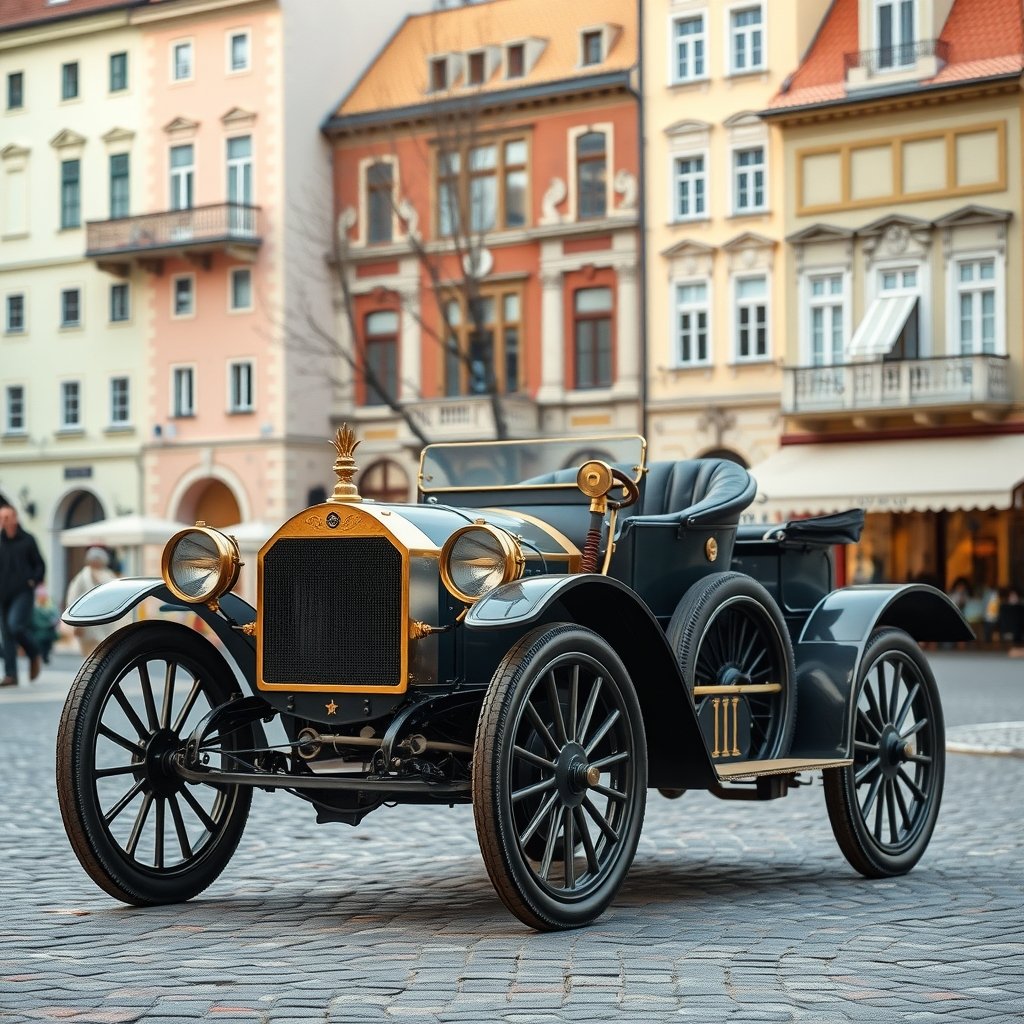
The history of the car in the modern sense begins in 1886, when Karl Benz patented his three-wheeled vehicle with a petrol engine. The first car reached Slovenia on 15 November 1898, driven by Baron Anton Codelli, but cars only became a mass product after 1913, when Ford introduced the moving assembly line. Below you will find the key milestones, the Slovenian chapters of the story and the places where you can still see early cars today.
Forerunners: steam, electricity and daring inventors
The idea of a horseless vehicle is older than the internal combustion engine. Leonardo da Vinci already sketched self-propelled carts, but the first genuine self-propelled vehicle was built in 1769 by French engineer Nicolas-Joseph Cugnot. His three-wheeled steam tractor was designed to haul artillery for the army and managed roughly 4 km/h.
In the 19th century inventors also experimented with electricity. Scotsman Robert Anderson built an electric carriage between 1832 and 1839, which shows that electric drive is not a modern invention at all but one that has returned after almost two centuries.
1886: the year the car was born
On 29 January 1886 Karl Benz filed German patent DRP 37435 for a “vehicle powered by a gas engine”. The tricycle had a single-cylinder four-stroke engine of 954 cc producing less than one horsepower, yet it ran reliably under its own power. At almost the same time, Gottlieb Daimler and Wilhelm Maybach built a four-wheeled vehicle with a four-stroke engine in Cannstatt.
Bertha Benz was crucial to the invention’s success. In August 1888, without telling her husband, she drove with their two sons from Mannheim to her mother’s home in Pforzheim, a journey of roughly 100 kilometres. She bought fuel from pharmacies along the way, and the trip proved to the public for the first time that a car could cover longer distances.
From workshop craft to the assembly line
Early cars were hand-built toys for the wealthy. The turning point came with Henry Ford, who launched the Model T in 1908 and introduced the moving assembly line in 1913. Assembly time per car dropped from 12.5 hours to about 93 minutes, prices fell, and by 1927 more than 15 million Model Ts had left the factories.
| Year | Milestone |
|---|---|
| 1769 | Cugnot’s steam carriage, the first self-propelled vehicle |
| 1832–1839 | Anderson’s electric carriage |
| 1886 | Benz patent DRP 37435 and Daimler’s four-wheeler |
| 1888 | Bertha Benz’s first long-distance drive |
| 1898 | first car in Ljubljana (Anton Codelli) |
| 1908 / 1913 | Ford Model T and the assembly line |
| 1972 | Slovenia’s first motorway, Vrhnika–Postojna |
The first car in Slovenia: Codelli’s “devil’s carriage”
Baron Anton Codelli bought his Benz Velo in Vienna and drove it into Ljubljana on 15 November 1898. The car weighed about 360 kilograms, had two gears and travelled at around 20 km/h. The next day’s newspapers wrote of a “strange four-wheeler without horses”, boys ran after it, and in the countryside some people called it the devil’s carriage and even threw stones at it.
Curiously, under the road regulations of 1874 Codelli had to drive on the left. In early 1899 he set off on a long trip to Nice, where, according to the story, he lost the car at cards; soon afterwards he bought a more powerful Daimler Viktoria. Cars remained rare for years: some fifteen years later there were only about 60 in the whole of Carniola. The Carniolan Automobile Club was founded in 1909, and in 1920 the first motor race on Slovenian soil took place near Vrhnika.
The car becomes part of everyday life
After the Second World War, Ljubljana had 852 registered cars in 1949, and its first traffic light went up in 1956. Then things moved fast: Slovenia had around 62,000 cars in 1962 and roughly 350,000 by 1975. A key date was 29 December 1972, when the first 32 kilometres of Slovenian motorway opened between Vrhnika and Postojna.
Novo Mesto wrote an important chapter of its own. The local company was renamed Industrija motornih vozil (IMV) in 1959, signed a cooperation deal with Renault in 1972 and began assembling the Renault 4, the much-loved “katrca”, in 1973. Revoz was founded in 1989, has been wholly owned by Renault since 2004, and in July 2025 its five-millionth vehicle rolled off the line.
Legendary cars and classics: where to see them
If you want to see old cars up close, these are the best places in Slovenia:
- Technical Museum of Slovenia in Bistra near Vrhnika: the Naš dragi avto (Our Dear Car) exhibition covering more than a century of motoring in Slovenia, plus a collection of 15 of Tito’s cars, including a 1939 Mercedes 540K and a 1937 Packard given to Tito by Stalin. Since 1953 the museum has also kept a Piccolo, regarded as the oldest surviving passenger car in Slovenia. Visitor details are on the Technical Museum in Bistra page (in Slovenian).
- IMV museum collection in Drgančevje near Novo Mesto, with vehicles and caravans from the local industry.
- Classic car meets: the Codelli Club, founded in 1990, was Slovenia’s first officially registered club of vintage vehicle owners and organises the Slovenia Classic Marathon rally. Large gatherings such as the one in Vransko draw hundreds of vehicles.
Check opening hours and ticket prices before visiting the museum, as they vary by season. And at classic car meets one simple rule applies: look with your eyes, and touch a car only with the owner’s permission.
Frequently asked questions
What was the first car in the world?
The three-wheeled Benz Patent-Motorwagen is generally regarded as the first true petrol car. Karl Benz filed patent DRP 37435 on 29 January 1886. As early as 1769, Frenchman Nicolas-Joseph Cugnot had built a steam-powered vehicle.
Who owned the first car in Slovenia?
Baron Anton Codelli, who drove a Benz Velo from Vienna to Ljubljana on 15 November 1898. It is often described as the first car in the Balkans as well.
When did mass production of cars begin?
In 1913, when Ford introduced the moving assembly line. Building a Model T went from 12.5 hours to about 93 minutes, and more than 15 million were made by 1927.
Where can I see vintage cars in Slovenia?
At the Technical Museum of Slovenia in Bistra near Vrhnika, home to the Naš dragi avto exhibition and Tito’s car collection, and at the IMV museum collection in Drgančevje near Novo Mesto.
When did Slovenia get its first motorway?
The first 32-kilometre section between Vrhnika and Postojna opened to traffic on 29 December 1972.